When the Double Diamond Meets Machine Speed
How Whitney Tolley transformed a decades-old design framework for the AI era

Two years before ChatGPT became a household name, Whitney Tolley was already seeing the cracks in how UX teams approached design thinking.
Writing for the Cloudbeds Technology Blog in early 2023, she challenged the conventional wisdom around the Double Diamond—that beloved framework UX practitioners have relied on for nearly two decades.

Her critique was prescient: teams have been treating the Double Diamond like waterfall in disguise, creating rigid handoffs between discovery, definition, development, and delivery phases.
What she couldn't have predicted was how AI would elevate her position to new heights.
The Problem Hidden in Plain Sight
When Tolley asked ChatGPT how to integrate design thinking into agile development, the AI's response revealed something troubling. It recommended exactly what gets so many teams into trouble: sequential phases where "Team 1 does all the Discover, Team 2 does all the Define, and Team 3 does all the Develop." The result? Whatever you deliver was basically built by waterfall.
This wasn't just ChatGPT's limitation—it was crowdsourcing thousands of people's conventional wisdom about UX process. The bot was passing along what it heard: idealistic at best, out of touch with reality at worst.
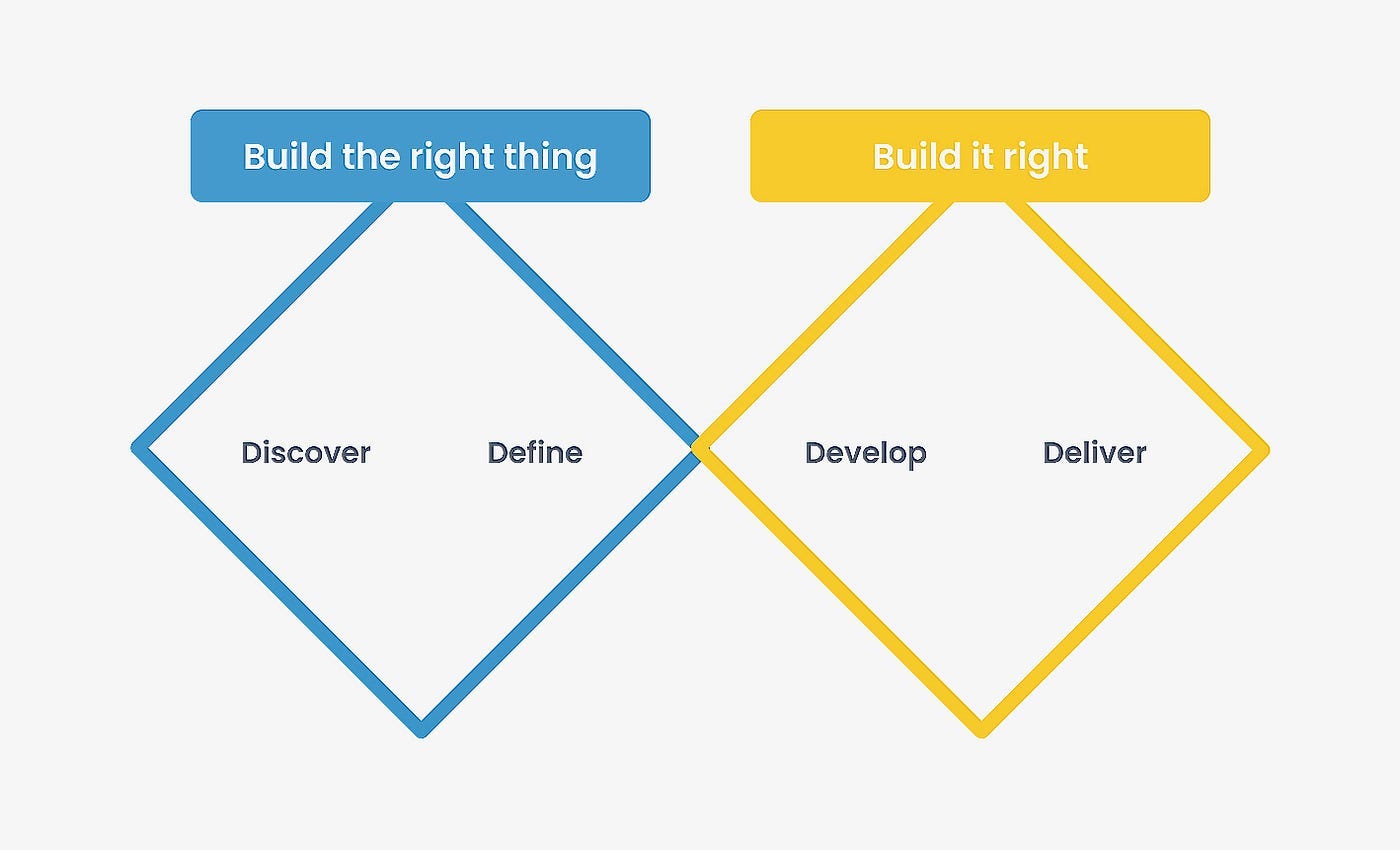
The traditional approach creates a predictable failure pattern. The second diamond collapses into a straight line because cost and time pressures mean only one or two solutions get developed and delivered.
Research gets front-loaded into the first phase, then risks identified later in the process get "accepted" rather than investigated.
Diamonds on Demand
Instead of treating the Double Diamond as one massive project-spanning process, Tolley conceptualized it as a flexible problem-solving tool that could be deployed quickly at any stage when appropriate.
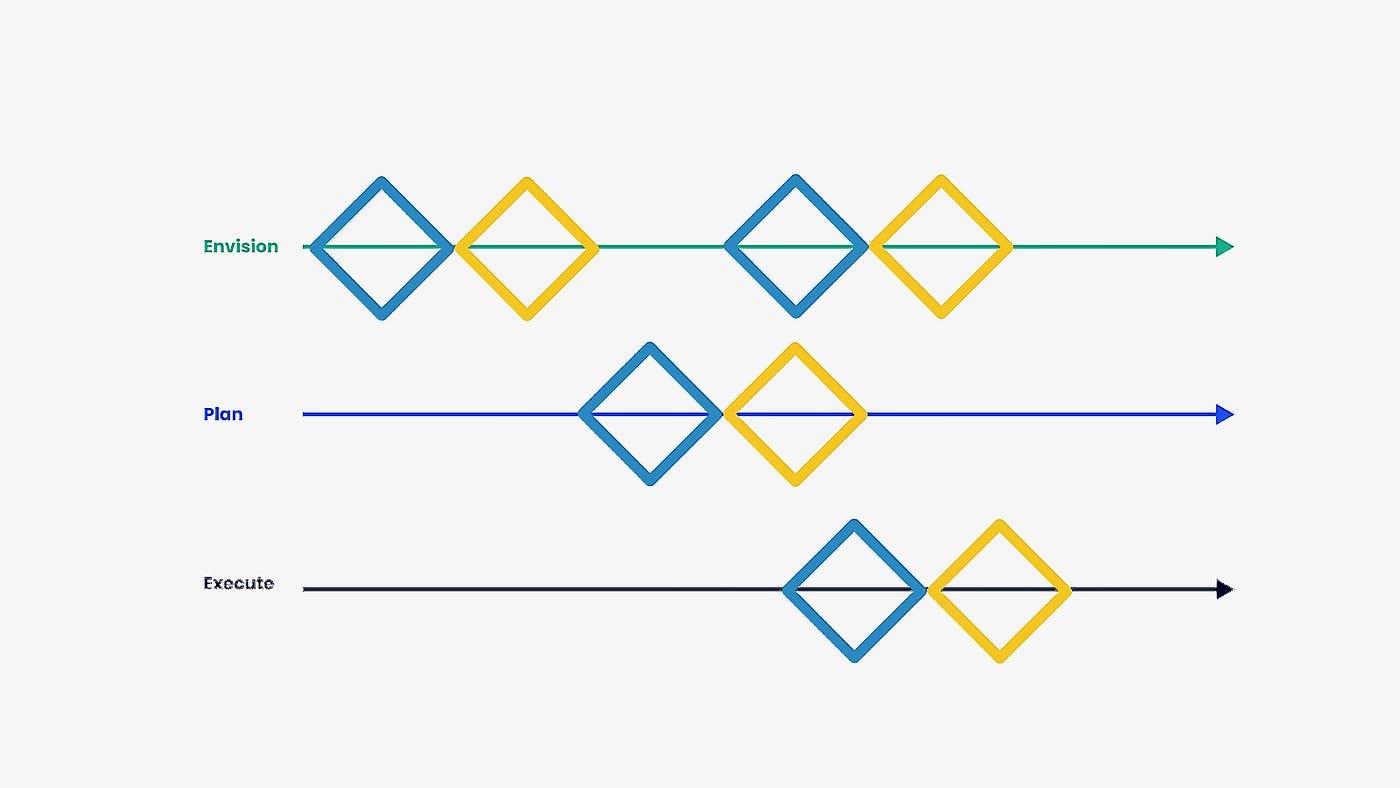
Her approach broke projects into three workstreams—Envisioning, Planning, and Executing—with each informing the others continuously. When questions requiring creative problem-solving emerged, they'd pull out mini Double Diamond exercises:
During Envisioning: Quick user research through surveys and interviews, followed by rapid prototyping to test solution approaches
During Planning: Fast problem-solving to determine feature priorities and release sequences, combining user input with development team insights
During Execution: Hackathons where developers and designers explore emerging technologies through proof-of-concept builds
The key insight: "We can do this safely with prototyping and inexpensively with low or no-code solutions, without dedicating an entire development sprint on this problem."
Why AI Changes Everything
Fast-forward to our recent conversation with Whitney, now Design Director at Cloudbeds, and the AI connection becomes clear. What seemed like process optimization in 2023 has become survival strategy in 2025.
AI acceleration means slow, sequential design thinking is long gone. But rather than replacing human designers, AI amplifies exactly the kind of flexible, rapid-iteration approach Whitney pioneered.
"AI can really help with those things that we're just not doing because we don't have time," she explains. "Help me write a compelling Slack message that recaps what we just did and gets people excited about how we spent that time and what we're doing next."
Her team experienced this firsthand during a two-day strategic workshop. When day one's exercises made day two's planned activities irrelevant, Whitney turned to AI for real-time replanning. "Over a 30-minute period, we had a completely new agenda for the next day... We can walk into day two and get better outcomes than say, two years ago where we would've just stuck to what we planned."
The Human-AI Partnership in Practice
This isn't about AI doing the work—it's about AI enabling better human judgment at machine speed. Whitney's team uses AI to:
Accelerate synthesis: Tools like Notebook LM help them get direct insights from recorded customer conversations and digital communications
Enable rapid pivoting: AI helps generate new workshop activities when original plans become irrelevant
Improve feedback loops: AI serves as a sounding board for designers to test ideas before presenting to stakeholders
Scale empathy research: AI helps process large volumes of customer feedback to identify patterns human researchers might miss
But the human element remains crucial. As Whitney notes from a customer interview: "She was telling us how she was helping answer our research questions... but between those research questions, she was sharing some additional insights... You're not going to get those extra human-provided stories that really shape what you end up designing" if you rely only on AI.
The Skills That Matter Now
Whitney's framework anticipated what many UX practitioners are just now realizing: the profession's value isn't in pixel-pushing or even wireframing. It's in the strategic application of human insight to complex problems.
The UX professionals thriving in her AI-augmented environment share specific characteristics:
Strong visual design sense: AI can generate layouts, but it takes human judgment to know when those recommendations violate good design principles
Comfort with ambiguity: Success requires "comfort with not having a defined role" and willingness to stretch beyond specialization
Strategic thinking: Moving beyond "could you figure out how to use it" to understanding user personas, pains, and gains
Cross-functional collaboration: The ability to work with AI as another team member providing direction and feedback
Lessons for the Broader UX Community
Whitney's Double Diamond evolution offers a blueprint for navigating AI disruption across the UX field. The principles apply beyond specific frameworks:
Stop treating AI as a threat to process. Like Whitney's team pivoting their workshop in real-time, AI should enable better decision-making, not replace it.
Embrace rapid iteration over perfect planning. The traditional approach of extensive upfront research followed by implementation has always been vulnerable to changing requirements. AI makes those changes happen faster, making flexibility essential.
Focus on uniquely human skills. Visual judgment, empathy, strategic thinking, and cross-functional collaboration become more valuable as AI handles tactical work.
Use AI to eliminate process friction. Those follow-up emails that never get sent, the synthesis that never happens, the documentation that falls behind—AI can handle these workflow gaps that derail good intentions.
The Bigger Picture
Whitney anticipated how fundamental workflow changes would require different approaches to familiar frameworks.
Her re-envisioning of the Double Diamond wasn't really about the Double Diamond at all. It was about maintaining user-centered design principles while embracing the speed and iteration requirements of modern product development.
Now, as AI accelerates those same pressures, her framework provides a model for keeping human insight at the center while leveraging machine capabilities for everything else. The Double Diamond survives, but as a flexible tool for rapid problem-solving rather than a rigid project structure.
The future of UX isn't about choosing between human judgment and AI capability—it's about combining them at the speed of user needs. Whitney's approach shows exactly how that combination works in practice.